
Swiss Water Filtration Standards: Why "Swiss Made" Matters
"Swiss Made" is not just a marketing label — in Switzerland, it is a legally defined designation governed by the Swissness Ordinance. For water treatment equipment, this has meaningful implications for manufacturing quality, material standards, and testing rigour.
Switzerland also hosts ETH Zurich University — consistently ranked among the world's top five technical universities — which operates independent water quality testing facilities used by both industry and regulatory bodies.
Understanding what Swiss manufacturing and testing standards actually entail helps you evaluate water filtration products more accurately, regardless of their origin.
What Swiss Made Legally Requires
The Swiss Made designation for industrial products is governed by the "Swissness" legislation (SR 232.111), which came into force in 2017. For manufactured products (as opposed to food or watches, which have separate rules), at least 60% of manufacturing costs must be incurred in Switzerland, with the last substantial manufacturing step performed in Switzerland.
This means a Swiss Made water filtration system cannot simply be assembled from imported components with a Swiss label. The primary value-adding steps — machining, welding, precision assembly, quality testing — must occur in Swiss facilities, under Swiss labour standards and regulatory supervision.
For consumers, this matters because Swiss manufacturing facilities are subject to strict environmental and quality management requirements under ISO 9001 and Swiss industrial regulation, enforced by SECO (State Secretariat for Economic Affairs).
Swiss Material Standards: 316L Stainless Steel
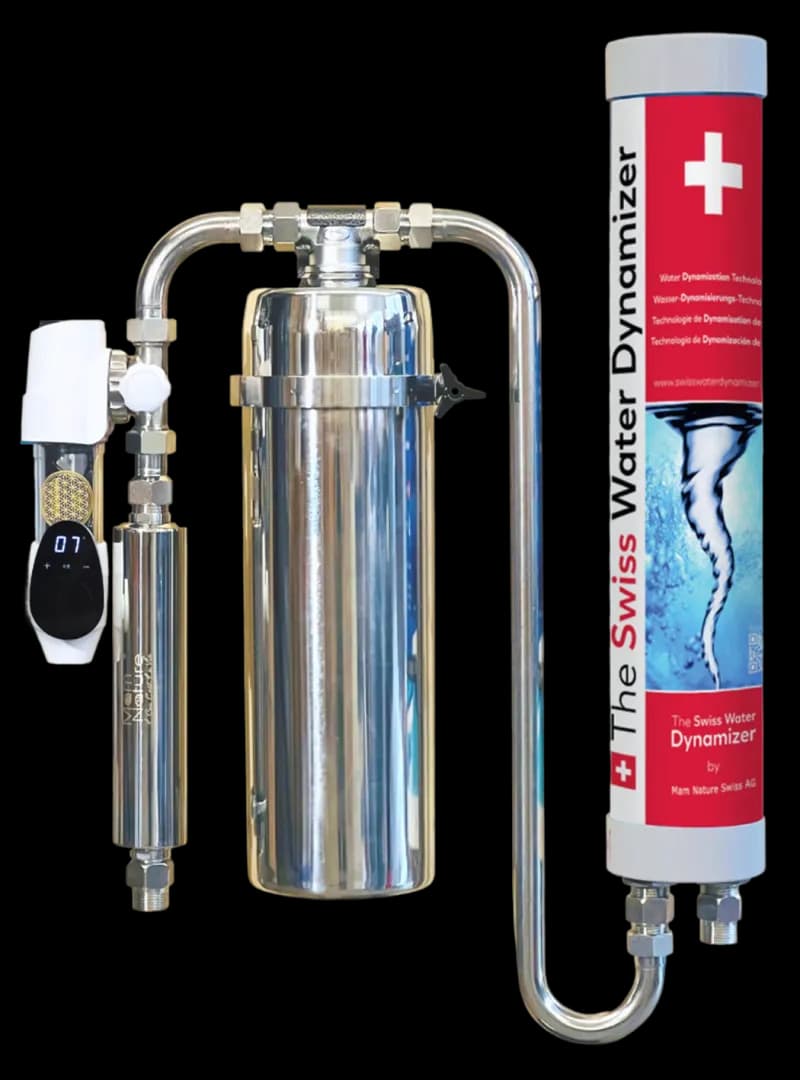
Mam Nature products are manufactured from 316L stainless steel — the medical and food-grade alloy used in pharmaceutical equipment, surgical instruments, and food processing. The "L" designation indicates ultra-low carbon content (below 0.03%), which prevents carbide precipitation during welding and maintains corrosion resistance at welds.
The key property of 316L for water contact is its exceptional resistance to pitting corrosion in chloride environments. Tap water contains chloride ions, particularly in areas where salt-based softeners discharge into wastewater and chloride percolates back into groundwater. In standard 304 stainless steel (the more common grade used in cheaper products), this can lead to stress corrosion cracking and iron leaching over time.
316L steel also meets FDA 21 CFR requirements for direct food contact and EU Regulation 10/2011 for food-contact materials — standards that many imported water treatment components using cheaper alloys do not satisfy.
ETH Zurich University: What Their Certification Actually Means
The Swiss Federal Institute of Technology (ETH Zurich University), founded in 1855, operates multiple research groups specialising in water quality, environmental engineering, and material science. The Mam Nature Swiss Fine Filter was independently tested at ETH Zurich University by Dr. Sreenath Bolisetty (Department of Health Sciences & Technology) in October 2025.
Testing of the Mam Nature Fine Filter involved standardised challenge testing: spiking water samples with known concentrations of PFAS compounds, heavy metals, and BPA, passing the water through the Fine Filter under controlled conditions, and measuring the difference between influent and effluent concentrations using validated methods (ICP-MS/ICP-OES, EPA 537M for PFAS).
The resulting retention rate data — >96–>98.5% for PFAS, up to 99.98% for heavy metals, 97.87% BPA removal — represents reproducible performance data generated by an institution with no commercial relationship with Mam Nature. This is methodologically distinct from self-reported vendor testing or unverified manufacturer claims.
Swiss Drinking Water Regulation vs. EU and International Standards
Switzerland operates its drinking water quality regulation primarily through the Lebensmittel und Gebrauchsgegenständeverordnung (LGV) and the specific Trinkwasserverordnung (TBVO), which are maintained by the Federal Food Safety and Veterinary Office (FSVO).
Swiss standards for many parameters are aligned with or stricter than EU Drinking Water Directive limits. Switzerland participates in European Environment Agency monitoring programmes and contributes to international standard-setting through membership of the WHO European Regional Office.
For water treatment device performance claims, the Swiss Federal Office of Metrology (METAS) and accredited test labs provide the framework for validated performance data — a more rigorous context than many countries where performance testing is largely self-regulated by manufacturers.
How to Evaluate Any Water Filtration Product's Claims
When evaluating any water filtration product, apply these questions: Who performed the testing? Is it the manufacturer, a paid third-party lab, or an independent accredited institution? Is the testing methodology described in enough detail to be reproducible? Are the test conditions (flow rate, contaminant concentration, pH, temperature) representative of real household use?
NSF International, the Water Quality Association (WQA), and European equivalents like DIN CERTCO provide certification programmes that test filters under standardised conditions. Independent academic testing at ETH Zurich University using validated methods (ICP-MS, EPA 537M) applies the same rigour within an academic research context.
Be sceptical of filtration claims that do not cite specific retention percentages for specific contaminants under specific test conditions. "Removes 99% of contaminants" without specifying which contaminants, at what concentration, and by what measurement method is not a verifiable claim.
The Mam Nature Swiss Manufacturing Process
Mam Nature products are designed and manufactured in Switzerland, using 316L stainless steel components machined and assembled at Swiss facilities under ISO 9001 quality management. The filtration media for the Fine Filter — the protein-fibre selective adsorption matrix — is proprietary and manufactured in Switzerland.
The filtration design incorporates Swiss precision engineering principles: exact tolerances in the flow path geometry to ensure uniform contact time between water and filtration media, structural integrity for long-term high-pressure operation, and zero-maintenance serviceability for the lifetime of the unit.
Each unit undergoes pressure testing and flow verification before shipment. The Swiss Made designation is supported by full manufacturing documentation available to regulators and, on request, to consumers.
See our lab reports and ETH Zurich University certification.
View CertificationsRelated Resources
Frequently Asked Questions
What does Swiss Made legally require for water filters?
Under the Swissness Ordinance (SR 232.111), at least 60% of manufacturing costs must be incurred in Switzerland, and the final substantial manufacturing step must be performed in Switzerland. This prevents the designation from being applied to products merely labelled or assembled in Switzerland from foreign-made components.
Is ETH Zurich University certification the same as NSF certification?
They are different but complementary. NSF International provides standardised commercial certification widely used in North American markets. ETH Zurich University testing is independent academic research using validated analytical methods (ICP-MS, EPA 537M) at one of the world's top technical universities — independent, reproducible, documented performance measurement. Mam Nature Swiss separately holds ISO 13485:2016 certification for its manufacturing quality management system (MSECB, CERT-001116).
Why is 316L stainless steel better than 304 for water contact?
316L contains molybdenum (2–3%), which dramatically improves resistance to pitting corrosion from chloride ions present in tap water. Its ultra-low carbon content prevents carbide precipitation at welds, maintaining corrosion resistance throughout the structure. 304 steel is adequate for many kitchen uses but is more prone to micro-pitting in long-term pressurised water contact.
How can I verify a product's Swiss Made claim?
Legitimate Swiss Made products can provide documentation of their manufacturing location and cost breakdown. SECO (State Secretariat for Economic Affairs) enforces the Swissness Ordinance and handles complaints about misuse of the designation. You can also request the specific ETH Zurich University test report number and verify it directly with the institution.
Do Mam Nature products have certifications beyond ETH Zurich University?
Mam Nature products are certified under Swiss material standards for food-contact 316L stainless steel (meeting EU Regulation 10/2011 and FDA 21 CFR). ETH Zurich University performance testing covers contaminant retention. Full certification documentation is available at mam-nature.com/reports-certifications.
Sources & References
- Swiss Institute for Standardization (SNV). Swiss manufacturing and materials standards (SN EN ISO).
- European Commission (2020). Directive 2020/2184 on the quality of water intended for human consumption.
- Swiss Federal Council (2017). Ordinance on Foodstuffs and Utility Articles (LGV) SR 817.0.
- ISO 13485:2016. Medical devices — Quality management systems — Requirements for regulatory purposes.