

Point of Entry Water Filter: What It Is, How It Works, and Who Needs One
When you buy a water filter for your kitchen tap, you are solving a small part of the problem. That filtered water reaches one faucet. The water in your shower, your washing machine, your dishwasher, your ice maker, and every other tap in the house continues to arrive unfiltered.
A point of entry (POE) water filter solves the whole problem. It connects to your home's main water supply line — the single pipe through which all water enters — and treats everything before it distributes through your plumbing. Every tap in the house delivers filtered water.
This guide explains how POE systems work, what they can and cannot remove, how they compare to point-of-use alternatives, and what to look for when choosing one.
What "Point of Entry" Means
The terms "point of entry" and "point of use" describe where in a home's plumbing a filter is installed, not how it works internally.
A point of entry system connects at the main supply line, typically near the water meter or where the supply pipe enters the building. Because all household water flows through this single connection before branching to individual fixtures, a POE filter treats 100% of your household water supply — drinking water, bathing water, cooking water, and appliance water simultaneously.
A point of use system installs at a single outlet: under a kitchen sink, at a single faucet, or on a countertop. It treats only the water drawn from that one point.
Why Treating Water at the Mains Matters
Many contaminants affect the body through routes other than drinking. PFAS, chlorine byproducts, and volatile organic compounds (VOCs) are absorbed through skin during showering and inhaled as steam. Studies published in the Journal of Exposure Science & Environmental Epidemiology have found that dermal and inhalation exposure to chloroform (a trihalomethane) can equal or exceed ingestion exposure for a person taking a daily shower.
Hard water and limescale affect appliances, not just drinking quality. A washing machine operating in hard water accumulates calcium carbonate deposits that reduce heating element efficiency by up to 12% per 1.6mm of scale, according to the Water Quality Research Foundation. A dishwasher, boiler, and combi heating system are similarly affected.
Sediment — fine particles of rust, sand, and mineral debris — causes wear in washing machine solenoid valves, dishwasher spray arms, and shower heads. Filtering at the mains protects the entire plumbing system, not just the drinking water.
How a POE Filter Works
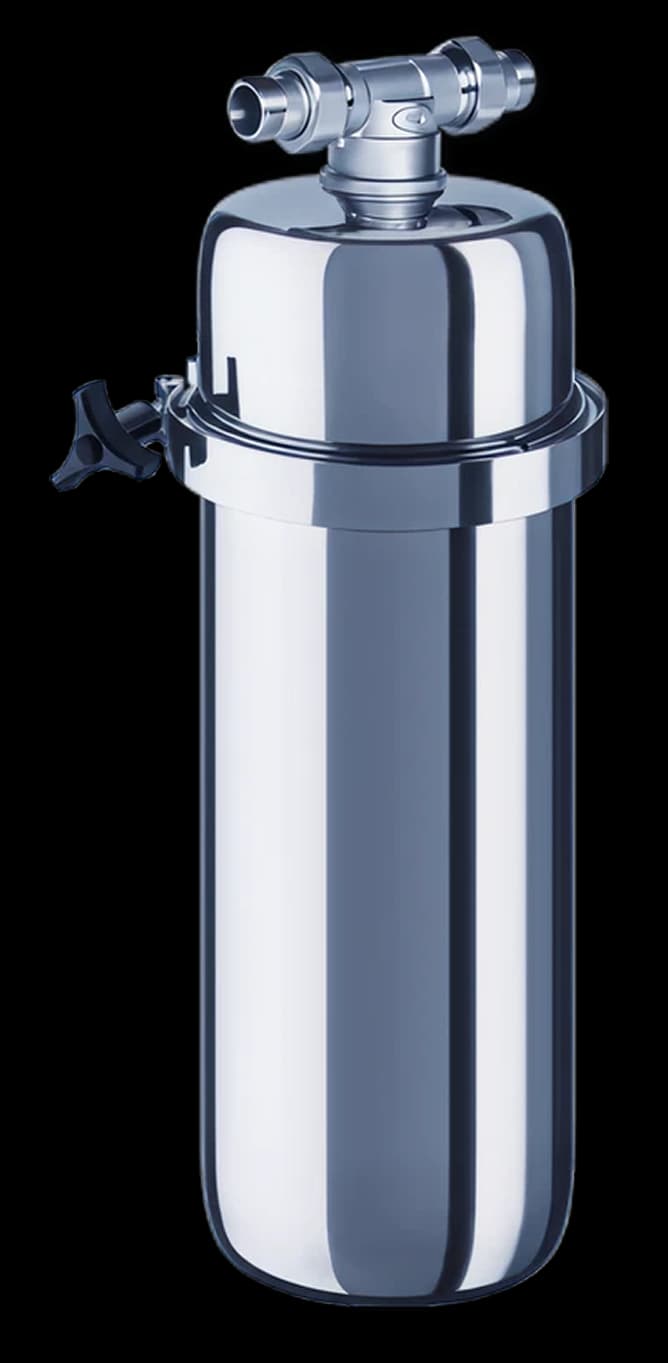
Most residential POE filters consist of a stainless steel or polymer housing containing a replaceable filter cartridge. The housing connects inline on the main supply pipe — water enters one end, passes through the filter media, and exits the other end into your household distribution plumbing.
The filter media determines what is removed. The three main types used in residential POE systems are activated carbon (removes chlorine, VOCs, some pesticides; limited PFAS removal), mechanical/sediment membranes (removes particles above a threshold micron rating; does not remove dissolved contaminants), and adsorption media such as protein-fibre or ion exchange (removes dissolved contaminants including PFAS, heavy metals, and nitrates selectively).
The Mam Nature Fine Filter cartridge uses an amyloid protein-fibre adsorption matrix, developed in collaboration with ETH Zurich University. Unlike activated carbon, the protein-fibre matrix binds PFAS, heavy metals, and microplastics selectively while allowing calcium, magnesium, and bicarbonate — the naturally occurring minerals you want to keep — to pass through unchanged. This is called selective adsorption.
Because no electricity is required (water pressure from the main supply drives the flow), POE adsorption systems operate at 0 kWh. There is no pump, no pressurised holding tank, and no brine discharge.
Flow Rate — Why It Matters More for POE Than POU
A point-of-use filter under a sink handles one tap at a time. It can be slow — 1–2 litres per minute — without inconveniencing anyone. A point of entry filter must handle peak household demand: two showers running simultaneously, a dishwasher filling, and someone cooking, all at the same time.
The correct metric is peak flow rate, measured in litres per hour (L/h). For a single-family home of three to five people, a POE filter should sustain at least 1,200 L/h without significant pressure drop. Larger homes or homes with multiple bathrooms benefit from systems rated at 1,800 L/h or higher.
The Mam Nature Essential and Essential Plus systems are rated at greater than 1,800 L/h — adequate for most single-family homes. The Complete Set and Complete Set Plus maintain the same flow rating because the filter housings are sized and plumbed in a configuration that does not create a bottleneck at peak demand.
POE vs Point of Use — Which Is Right for You
A point-of-use filter is the right choice when the concern is limited to drinking and cooking water only, installation space at the mains is unavailable or prohibited (rented property, apartment), or the budget does not stretch to a whole-house system.
A point of entry filter is the right choice when the concern includes dermal exposure (PFAS, chlorine, VOCs in shower steam), when appliance protection matters (limescale from a whole-house hard water solution, sediment from a particle pre-filter), when the property has young children or immunocompromised occupants who shower or bathe daily, or when the household is owner-occupied and a permanent installation makes economic sense.
For PFAS specifically, a point-of-use filter at the kitchen tap addresses ingestion exposure but not dermal/inhalation exposure. Research from the Silent Spring Institute has identified showering as a meaningful PFAS exposure route for compounds with high vapour pressure. Only a POE system addresses both routes simultaneously.
Installation Overview
A standard residential POE installation requires cutting into the main supply pipe, fitting a bypass valve, and connecting the filter housing inline. The work takes one to two hours for a plumber or a competent DIYer with basic pipe tools.
Mam Nature POE systems ship with a drill template and installation guide for common pipe configurations. The housings use 1" BSP connections, standard across European residential plumbing. No electrical connection is needed.
Once installed, the only ongoing maintenance is the annual cartridge replacement — a 10-minute procedure that requires no tools. The housing is rated for a 10-year service life.
What to Look for When Buying a POE System
Independent laboratory validation is the most important criterion. Look for results measured single-pass (inlet to outlet, no recirculation) from a named institution, not internal manufacturer testing. ETH Zurich, NSF International, and accredited EU notified bodies are recognised independent validators.
Filter media transparency matters. Ask specifically what the cartridge contains and what it does not remove. Activated carbon is widely marketed as a whole-house filter media but provides limited removal of PFAS, heavy metals, and nitrates.
Flow rate must match peak household demand, not average demand. A filter that handles 600 L/h will create noticeable pressure drops the moment two showers run simultaneously.
Housing material affects long-term safety. Medical-grade stainless steel (316L) does not leach plasticisers or corrode over time. Lower-cost polymer housings may leach BPA or phthalates, particularly in hot-water applications.
Swiss-made POE filtration for every tap in your home. ETH Zurich-validated, 10-year warranty.
Explore Whole-House SystemsRelated Resources
Frequently Asked Questions
Does a point of entry filter reduce water pressure?
A well-designed POE filter causes negligible pressure drop at rated flow. The Mam Nature Essential and Essential Plus systems are rated at greater than 1,800 L/h with a pressure drop of less than 0.3 bar at full flow — imperceptible in normal household use. Undersized systems with clogged cartridges will reduce pressure; the solution is correct sizing and annual cartridge replacement.
Can a POE filter be installed in a rented property?
This depends on the tenancy agreement and landlord approval. POE installation requires a permanent connection to the mains supply pipe, which most landlords classify as a structural modification. Point-of-use filters (under-sink or countertop) are usually permitted without landlord consent. Check your tenancy agreement before purchasing.
What is the difference between POE and a water softener?
A water softener is a specific type of POE system that removes calcium and magnesium ions (hardness) through ion exchange with sodium ions, using salt for regeneration. A POE adsorption filter removes dissolved contaminants (PFAS, heavy metals, chlorine, pesticides) without removing minerals and without using salt. They solve different problems; some homes benefit from both.
How often does a POE filter cartridge need replacing?
For a family of four on a typical European or North American municipal supply, once per year. Cartridge life is measured in total volume processed. Heavy sediment or high-turbidity well water may reduce service life. The Mam Nature cartridge is rated for approximately 150,000 litres, which equates to roughly 12 months for an average household.
Does a POE filter remove minerals?
This depends entirely on the filter media. Reverse osmosis POE systems remove minerals (calcium, magnesium) along with contaminants. Adsorption-based systems like the Mam Nature Fine Filter are selective — they bind PFAS, heavy metals, and microplastics while allowing naturally occurring minerals to pass through, preserving the water's taste and mineral content.
Sources & References
- Gordon, S.M., et al. (2006). "Changes in breath trihalomethane levels resulting from household water-use activities." Environmental Health Perspectives 114(4), 514–521.
- Water Quality Research Foundation (2009). "Scale Buildup in Residential Water Heaters." Technical Report.
- Gobelius, L., et al. (2018). "Plant uptake of per- and polyfluoroalkyl substances at a contaminated fire training facility." Environmental Science & Technology 52(21), 12126–12135.
- Mam Nature Swiss AG — ETH Zurich University Laboratory Performance Certificate (2024). Independent filtration validation.
- Bolisetty, S., Peydayesh, M., Mezzenga, R. (2020). Sustainable technologies for water purification from heavy metals: review and analysis. Chemical Society Reviews 49, 463–487.