Whole-House Filtration vs. Reverse Osmosis: How the Systems Differ
Choosing between a whole house water filter and a reverse osmosis system is one of the most common questions in home water treatment. Both remove contaminants, but they work on different principles and suit different needs.
The right answer depends on your water quality, household size, budget, and priorities around mineral retention, water waste, and installation complexity.
This article is the technical explainer: it focuses on how the two systems work and how to read their evidence. For a purchase-oriented scorecard and recommendation, use the linked commercial comparison hub; for measured reject-water ratios, use the dedicated water-waste guide.
How Each Technology Works
A whole house water filter (point-of-entry or POE system) is installed at the main water line entering your home. All water — for drinking, cooking, bathing, and laundry — passes through the filter before reaching any tap or appliance. Filtration mechanisms vary by system: sediment filtration, activated carbon, catalytic carbon, ceramic, or selective adsorption.
Reverse osmosis (RO) forces water under pressure through a semi-permeable membrane with pores of 0.0001 microns — small enough to exclude nearly all dissolved solids, including minerals, heavy metals, PFAS, nitrates, and bacteria. Most under-sink RO systems are point-of-use (POU), treating only water from a single tap.
Whole house RO systems exist but are not recommended in residential settings due to the aggressivity of demineralized water to the piping system in the building. Additional problems are high cost, large footprint, and significant water waste.
Contaminant Removal: What Each System Handles
RO membranes remove 90–99% of virtually all dissolved contaminants: heavy metals, PFAS, nitrates, fluoride, arsenic, sodium, chlorine, chloramines, bacteria, and viruses. It is arguably the most comprehensive single-stage filtration technology available. But for 1 tap in the kitchen only.
Whole house selective adsorption filters such as the Mam Nature Fine Filter achieve >96–>98.5% PFAS retention and heavy-metal retention up to 99.98%, while also reducing pesticides, chlorine, BPA, and pharmaceuticals. Unlike RO, selective adsorption does not remove all dissolved minerals — it is specifically engineered to target contaminants while preserving calcium, magnesium, and potassium.
If your primary concern is bacterial contamination or very high nitrate levels, RO can be one solution — but, as already said, only for one tap in the kitchen. If your primary concern is a whole-house solution for PFAS, heavy metals, and organic chemical removal with mineral preservation, selective adsorption whole-house filtration is a very valuable approach.
Mineral Retention: A Critical Health Consideration
RO's thoroughness is also its most significant health trade-off: it removes 95–99% of calcium and magnesium from drinking water. The World Health Organization (WHO) published a report in 2009 noting that de-mineralised water is associated with increased cardiovascular risk, higher dietary mineral leaching, and impaired taste.
The WHO recommends minimum levels of 25–50 mg/L magnesium and 50–100 mg/L calcium in drinking water. Most RO permeate contains 2–10 mg/L of each — well below these thresholds. Many RO systems add a re-mineralisation stage to partially compensate, but this adds cost and complexity.
Whole house selective adsorption systems retain natural mineral content while removing contaminants, delivering water that is both clean and nutritionally appropriate.
Water Waste: A Practical and Environmental Factor
Traditional RO systems waste 3–5 litres of water for every 1 litre of purified water produced. Modern high-efficiency RO systems with permeate pumps can achieve 1:1 ratios, but at significantly higher cost.
For a Swiss household consuming 150 litres per day, a conventional RO system operating at 4:1 ratio wastes 450 additional litres per day — 164,000 litres annually. At Swiss water tariffs of 3–5 CHF/m³, this adds 490–820 CHF per year to your water bill.
Whole house filtration systems using sediment, carbon, or selective adsorption produce zero wastewater — 100% of the incoming water passes through and is available for use.
Cost Comparison: Installation, Maintenance, and Running Costs
Under-sink RO units typically cost 300–800 CHF for a quality system plus 100–200 CHF/year in filter and membrane replacement. Whole house RO systems range from 2,000–8,000 CHF installed, plus significant ongoing maintenance.
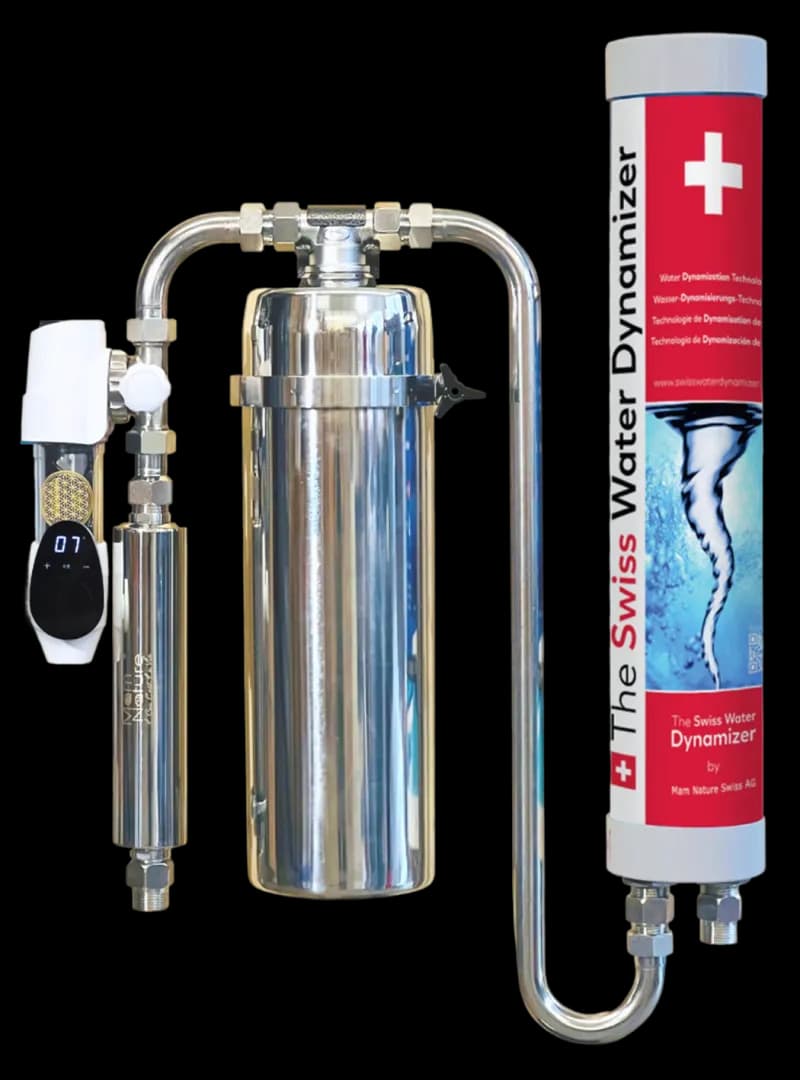
A Mam Nature whole house system (particle filter, fine filter, and dynamizer) provides comprehensive treatment for the entire home. Filter replacement intervals are long, and there are no membranes to replace. Total cost of ownership over 10 years is typically lower than a full-home RO installation when factoring in water waste savings.
Importantly, whole house treatment means every shower, bath, and glass of water is filtered — protecting skin, hair, and respiratory health during bathing as well as digestion during drinking. Under-sink RO only treats the single tap it is connected to.
Which System Is Right for Your Situation?
Choose a whole house filter with selective adsorption if your concerns are PFAS, heavy metals, chlorine, and pesticides; you want to preserve minerals; you have a family or use significant water volume; and you prefer low-maintenance, zero-wastewater operation.
Consider adding a point-of-use RO if your water has very high nitrate levels (above 25 mg/L), bacterial risk from a private well, or arsenic contamination — situations where the extra purification of RO at the drinking tap adds genuine value.
For most Swiss households on municipal water, a whole house selective adsorption system provides the optimal balance of comprehensive contaminant removal, mineral retention, water efficiency, and cost over a 10-year horizon.
Swiss whole house filtration — clean water from every tap.
Explore Our SolutionsRelated Resources
Frequently Asked Questions
Is a whole house filter as effective as reverse osmosis?
For most residential contaminants, a high-quality selective adsorption whole house filter achieves >96–>98.5% PFAS retention and heavy-metal retention up to 99.98%, while also reducing chlorine and BPA. RO has the advantage for nitrates, fluoride, and bacterial contamination. The key difference is that RO also removes beneficial minerals, while whole house filters preserve them.
Does reverse osmosis remove PFAS?
Many certified RO systems reduce specified PFAS, but performance is product- and compound-specific. Check the exact certification or performance sheet rather than applying a category-wide percentage. The cited Mam Nature report records >96–>98.5% reduction for seven named PFAS (PFBA, PFHxA, PFHpA, PFOA, PFBS, PFHxS and PFOS) under controlled single-pass conditions; it does not establish performance for every PFAS.
How much water does a reverse osmosis system waste?
EPA says a typical point-of-use RO system sends at least 5 litres to drain for every litre treated. WaterSense-labelled models must send no more than 2.3 litres to drain per litre treated. At 8 litres of treated drinking water per day, those ratios equal about 14,600 or 6,716 litres of annual reject water; use the certified ratio for the model you are considering.
Can I install a whole house water filter myself?
Whole house water filters require connection to the main water supply line, which in Switzerland typically requires a licensed plumber for warranty and insurance compliance. The Mam Nature installation service includes a certified plumber and takes, in ideal conditions, approximately 2–3 hours.
Does filtered water still contain minerals?
This depends on the filtration technology. Reverse osmosis removes 95–99% of all minerals. Selective adsorption and carbon-based whole house filters are designed to retain minerals while removing contaminants — delivering water that is both clean and naturally mineralised.
Sources & References
- WHO (2009). Nutrients in Drinking Water. World Health Organization.
- US EPA. Point-of-use reverse osmosis water efficiency and typical reject-water ratio.
- US EPA WaterSense. Specification for point-of-use reverse osmosis systems.
- EFSA (2020). Risk to human health related to PFAS in food. EFSA Journal 18(9):6223.