

Salt-Free Water Softener Alternatives: What the Science Says in 2026
Interest in salt-free water softener alternatives has grown significantly as environmental regulations on salt discharge tighten across Europe, dietary sodium concerns rise, and homeowners grow tired of the maintenance burden of monthly salt refilling. Finally, the biggest concern is the bacterial charge in water softeners (if not meticulously subjected to hygiene maintenance every 2 months — which nobody does: in best-case practice, such hygiene maintenance is done once a year). The market response has been an expanding range of physical and chemical conditioning devices — some well-validated, some poorly understood.
This guide assesses each main category of salt-free anti-scale technology on the evidence that actually exists: peer-reviewed laboratory studies, independent field trials, and the honest limitations acknowledged by researchers. Magnetic conditioning, template-assisted crystallisation, catalytic media, and the specific approach used in the Water LIME are each examined on their own merits.
The conclusion is not that one technology wins universally. It is that the effectiveness of any salt-free method depends critically on your water's hardness level, temperature, and flow conditions — and that honest claims about operating range matter more than marketing superlatives.
Why Households Are Moving Away from Salt-Based Softeners
The regulatory environment for residential salt-based water softeners has shifted materially in the past decade. Several Swiss cantons have introduced restrictions on new installations of ion exchange softeners in areas where wastewater treatment plants cannot efficiently process increased sodium loads. In Germany, the DVGW (Deutscher Verein des Gas- und Wasserfaches) has published guidance noting that salt-based softener brine discharges raise wastewater sodium chloride concentrations in ways that affect downstream treatment efficiency. In the United States, California's State Water Resources Control Board has banned the sale of certain portable exchange water softeners in defined watershed zones.
The household-level drivers are quite substantial. A typical family of four operates a salt-based softener consuming 4–10 kg of salt monthly, according to Water Quality Association data — requiring a physical salt delivery or carry every few weeks. Households where a member has hypertension or follows a low-sodium dietary regimen face the additional problem that softened water adds sodium to every litre consumed. And at the end of the softener's service life, the depleted resin requires hazardous waste treatment. These combined factors have created genuine demand for a technology that prevents scale without salt.
Template-Assisted Crystallisation (TAC)
Template-assisted crystallisation, also marketed as nucleation-assisted crystallisation or physical water treatment, uses a polymer bead media to provide nucleation sites that trigger calcium carbonate to crystallise in the bulk water as micro-crystals rather than on pipe and appliance surfaces. Unlike ion exchange, TAC does not remove calcium or magnesium from the water — it changes where and in what form they crystallise. Water downstream of a TAC unit retains full hardness mineral content but, in theory, those minerals are less likely to deposit on heated surfaces.
The peer-reviewed evidence for TAC is mixed. A 2011 study published in Water Research by Gabrielli et al. found measurable reduction in scale formation on heated surfaces under controlled laboratory conditions. A subsequent independent field trial conducted by the DVGW in 2014 found performance to be variable across real-world installations, with statistically significant scale reduction observed in water at moderate hardness (180–300 mg/L CaCO₃) but less consistent results at hardness levels above 400 mg/L. TAC media requires periodic replacement (typically every 3–5 years) and performance degrades in high-flow or high-temperature conditions where the contact time between water and nucleation beads is reduced. For moderate hardness levels, TAC is a legitimate option with a reasonable evidence base. For very hard water above 500–600 mg/L CaCO₃, the evidence is less convincing.
Magnetic and Electromagnetic Conditioners
Magnetic water conditioners have attracted more than forty years of experimental investigation, and the science, while genuinely complicated, has reached a degree of consensus in recent peer-reviewed literature. The mechanism is now generally understood to involve the influence of a magnetic field on the crystal growth kinetics of calcium carbonate: under certain field strength and water flow conditions, the magnetic interaction favours the formation of aragonite over calcite. Calcite is the thermodynamically stable form of CaCO₃ that adheres readily to heated surfaces. Aragonite is a metastable polymorph that tends to remain in suspension and flush through plumbing without adhering.
For a detailed examination of the science, see the Mam Nature article on magnetic limescale treatment, which reviews the peer-reviewed literature on the aragonite–calcite transition and the conditions under which magnetic conditioning is and is not effective. The key variables identified by independent researchers are field strength, contact time (which depends on pipe diameter and flow rate), water temperature, and the presence of dissolved competing ions. Poorly designed magnetic devices — particularly thin bands or clip-on external magnets with low field strength — show inconsistent results. Properly engineered systems designed around the specific flow and hardness parameters of residential supply perform substantially better in validated field conditions.
Catalytic and Ceramic Media Conditioners
Catalytic or ceramic media conditioners work on a principle similar to TAC in that they aim to influence the crystal structure of calcium carbonate as it precipitates, rather than removing hardness ions from solution. The media typically consists of ceramic granules or structured polymer with catalytic surface properties that promote aragonite crystallisation over calcite.
The evidence base for ceramic catalytic conditioners is thinner than for TAC, with most performance data coming from manufacturer-funded studies or small-scale field reports rather than independent peer-reviewed trials. This does not mean they are ineffective — it means the level of evidence needed to make a strong performance claim is not yet established in the open scientific literature. Buyers evaluating catalytic media conditioners should look for independent laboratory testing that clearly states the inlet hardness, flow conditions, and temperature at which the device was tested. Claims based solely on manufacturer testimonials or in-house laboratory data should be treated with caution.
The Water LIME — Mam Nature's Approach
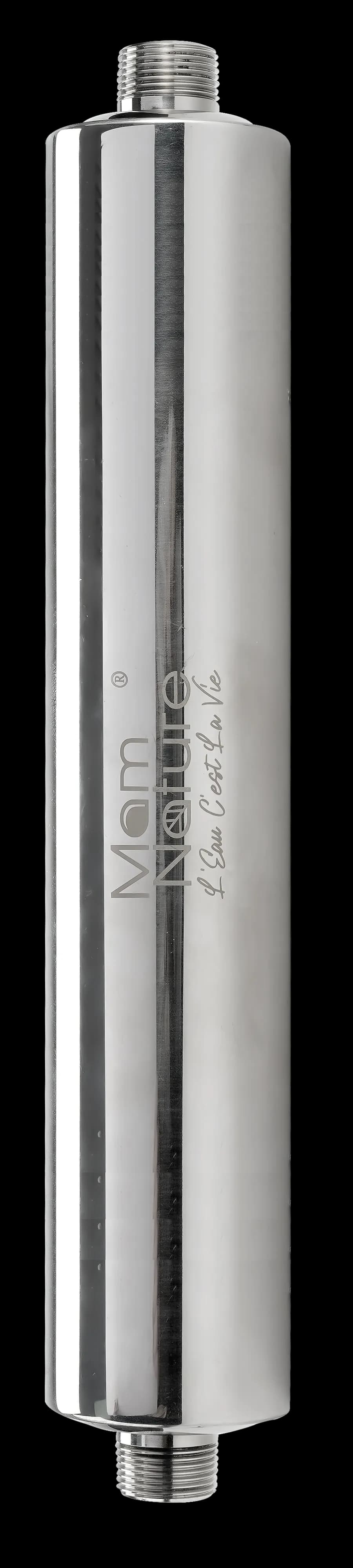
The Water LIME is Mam Nature's point-of-entry anti-limescale device. It uses a precisely engineered magnetic field configuration calibrated to residential water supply flow rates and standard European hard-water hardness ranges. As water passes through the device housing, the magnetic field influences the nucleation kinetics of calcium carbonate, promoting the formation of aragonite crystals rather than calcite. Aragonite, being the less adhesive polymorph, remains suspended in the water and flushes through plumbing, boilers, and heating elements without depositing on surfaces.
The device requires no salt, no electricity, no chemicals, and no annual consumables. It operates entirely through the physics of its magnetic field and the flow characteristics of the supply line. It is validated for European hard-water conditions in the 150–600 mg/L CaCO₃ range, which covers the hardness profiles of Switzerland, Germany, Belgium, the Netherlands, and parts of France. Within this range, the conversion of calcite to aragonite has been confirmed under conditions relevant to residential plumbing. Installation is at the point of entry — the same location as a whole-house filter — and the device works in combination with the Mam Nature adsorption cartridge in the Complete Set and Complete Set Plus configurations.
When Salt-Free Is Not Enough — Honest Caveats
Salt-free anti-limescale methods have meaningful operational limits, and honest communication of these limits is essential for buyers to make good decisions. At extreme hardness levels — water above 600 mg/L CaCO₃, which corresponds to approximately 33 °dH (German hardness) = 60 °fH (French hardness) = 35 grains per gallon, encountered in specific geological regions — the volume of calcium carbonate precipitating under heating conditions may exceed the capacity of physical conditioning methods to keep fully in suspension. At these extreme levels, a traditional ion exchange softener may be necessary for complete scale prevention, particularly in industrial or commercial applications of water used as non-drinking water, where very large volumes of very hard water are heated continuously.
For residential applications in Europe's hard-water regions, the majority of supply falls within 150–450 mg/L CaCO₃ — a range where the Water LIME and comparable well- designed magnetic conditioning devices have demonstrated meaningful scale reduction. The practical test of any anti-limescale device for your home is a before-and-after comparison of kettle scaling, showerhead deposits, and boiler service reports after twelve months of operation. Independently validated devices with traceable field performance data — rather than anecdotal claims — are the benchmark to apply.
The Complete Set combines the Water LIME anti-scale device with certified adsorption filtration — no salt, no electricity, one annual cartridge.
Explore the Complete SetRelated Resources
Frequently Asked Questions
Does a salt-free water softener actually soften water?
No — this is a significant terminology problem in the market. Salt-free devices do not remove calcium or magnesium from water, which means the water's measured hardness (in mg/L CaCO₃ or °dH) is unchanged. What salt-free conditioning devices aim to do is change the form calcium carbonate takes when it precipitates — from adhesive calcite crystals to non-adhesive aragonite — so that scale does not build up on surfaces. The water is still "hard" by any analytical measurement, but its scale-forming behaviour is reduced.
Can I use the Water LIME instead of a salt-based softener?
For most European households with hardness in the 150–600 mg/L range, yes — the Water LIME addresses the core problem that a salt-based softener is usually purchased for: preventing scale on boilers, dishwashers, showerheads, and pipe walls. The Water LIME achieves this without adding sodium to drinking water, without brine discharge, and without any ongoing salt cost. At extreme hardness above 600 mg/L CaCO₃, you should discuss with a specialist whether additional treatment is needed.
How long does the Water LIME last?
The Water LIME has no consumable media. Its magnetic field is permanent — the device does not require replacement of any internal component. Routine maintenance consists of a periodic visual inspection of the housing to verify the connection fittings remain sealed. The device is designed for the full service life of the installation.
What is the difference between the Water LIME and TAC?
Both aim to prevent scale adhesion without removing hardness minerals. The mechanisms differ: TAC uses polymer nucleation beads to trigger crystallisation in the bulk water; the Water LIME uses a magnetic field to influence crystal polymorph selection. TAC media requires replacement every 3–5 years; the Water LIME has no consumable. TAC has a somewhat broader evidence base in peer-reviewed literature, while the Water LIME has validated performance data specific to European residential conditions. Both are legitimate physical conditioning technologies for moderate hard-water conditions.
Does a salt-free anti-scale device also filter water contaminants?
No. Anti-limescale devices — whether magnetic, TAC, or catalytic — address only scale formation. They do not remove PFAS, heavy metals, chlorine byproducts, pesticides, or microplastics. If your water has both hardness and chemical contamination concerns — which is common in industrial and agricultural regions across Europe — you need both an adsorption filter and an anti-scale device. The Mam Nature Complete Set combines the Water LIME with the adsorption cartridge for exactly this purpose.
Sources & References
- Gabrielli, C., Jaouhari, R., Maurin, G., Keddam, M. (2011). Magnetic water treatment for scale prevention. Water Research, 45(10), 3252–3264.
- Water Quality Association (2024). Consumer Guide to Physical Water Treatment Systems.
- DVGW (2014). Physical water treatment — field study on scale prevention in residential hot water systems. Technical Report W 512.
- World Health Organization (2011). Guidelines for Drinking-water Quality, 4th ed. — Calcium, magnesium, and water hardness.
- Bolisetty, S., Peydayesh, M., Mezzenga, R. (2020). Sustainable technologies for water purification from heavy metals. Chemical Society Reviews 49, 463–487.