Calcite vs Aragonite: Understanding Limescale Crystal Types
Limescale is calcium carbonate (CaCO₃) — but not all calcium carbonate behaves the same way. The two most common polymorphs found in domestic water systems are calcite and aragonite, and the difference between them determines whether your pipes and appliances get coated with hard, adhesive deposits or remain scale-free.
Understanding crystal polymorphism explains the mechanism behind magnetic limescale treatment — and why the physics of magnetic water conditioning works despite sounding counterintuitive.
This article covers the crystallography, the practical consequences for plumbing and appliances, and the conditions that favour each crystal type.
What Are Polymorphs? The Same Molecule, Different Structures
A polymorph is a substance that can exist in more than one crystal structure while maintaining the same chemical composition. Carbon is a familiar example: graphite and diamond are both pure carbon, but their dramatically different crystal structures produce radically different material properties.
Calcium carbonate (CaCO₃) has three polymorphs relevant to water chemistry: calcite, aragonite, and vaterite. Calcite is the thermodynamically stable form under ambient conditions. Aragonite is metastable — it forms under specific conditions and can persist for long periods, but will slowly convert to calcite over geological time.
Vaterite, the third polymorph, is unstable under most conditions and quickly converts to calcite or aragonite. It is rarely significant in domestic water systems.
Calcite: The "Sticky" Crystal That Ruins Appliances
When calcium-rich water is heated — in a kettle, boiler, water heater, or dishwasher — CO₂ is released and the dissolved calcium precipitates as calcium carbonate. Under normal conditions, this precipitation follows the calcite crystal pathway.
Calcite crystals grow in a rhombohedral lattice — flat, interlocking plates that stack and interlock with each other and with metal and ceramic surfaces. This platelet geometry is the reason calcite limescale is so hard to remove: the crystals bond chemically to surface metal oxides and physically interlock with surface micro-roughness.
A 1 mm calcite limescale layer on a heating element reduces thermal efficiency by approximately 7%. A 5 mm layer — common in untreated hard water areas over 3–5 years — reduces efficiency by 30–40% and dramatically shortens element lifespan.
Aragonite: The "Soft" Crystal That Flushes Away
Aragonite has an orthorhombic crystal structure — needle-like or rounded crystals rather than flat plates. This geometry fundamentally changes how the crystals interact with surfaces. Without the plate-stacking mechanism, aragonite crystals cannot form the interlocking bonds that give calcite scale its adhesive strength.
Aragonite crystals remain dispersed in the water flow and flush away with normal water movement rather than accumulating on surfaces. Under the microscope, the difference is visually obvious: calcite forms rigid, geometric plates while aragonite produces rounded, discrete particles.
Even where aragonite does deposit on surfaces, the deposits are powdery and soft — easily wiped away with a damp cloth rather than requiring chemical descalers or mechanical scraping.
How Magnetic Treatment Triggers the Calcite-to-Aragonite Switch
The calcite-aragonite transition is sensitive to temperature, pressure, the presence of impurities, and electromagnetic fields. Aragonite formation is favoured at higher temperatures and in the presence of certain ions (Mg²⁺, Sr²⁺) and surfaces.
Magnetic water treatment introduces a controlled electromagnetic influence on the crystal nucleation process. When dissolved Ca²⁺ and HCO₃⁻ ions pass through a magnetic field, the field affects their orientation and the dynamics of ion-pair formation — the first step in crystal nucleation.
Specifically, the Lorentz force on charged ions in a flowing liquid deflects them preferentially. This altered ion trajectory changes the local ion concentration gradients at the nucleation point, shifting the thermodynamic balance toward the aragonite crystal pathway rather than calcite. The effect requires sufficient field strength and sufficient residence time in the magnetic zone — parameters that must be engineered correctly.
Conditions That Determine Which Polymorph Forms
Several factors influence whether calcite or aragonite precipitates from hard water. Temperature: aragonite formation is thermodynamically favoured above 82°C, which is why aragonite is common in geothermal water systems. Below this temperature, kinetic factors (nucleation rate, surface availability) become dominant.
Magnesium/calcium ratio: high Mg²⁺ concentrations inhibit calcite growth (because Mg²⁺ ions cannot easily fit into the calcite lattice) and promote aragonite. Seawater, which has a high Mg:Ca ratio, preferentially forms aragonite — the basis of marine shell composition.
Flow velocity: turbulent, fast-flowing water favours aragonite nucleation in the bulk solution rather than on surfaces, because crystals form in the flow before they can reach a surface. This is consistent with the observation that magnetic treatment is most effective at higher flow velocities.
Practical Implications for Home Water Systems
If your home water system is producing hard, adherent scale on heating elements, shower heads, and pipe surfaces, your water is precipitating calcite. This is the normal situation in hard water areas without any treatment.
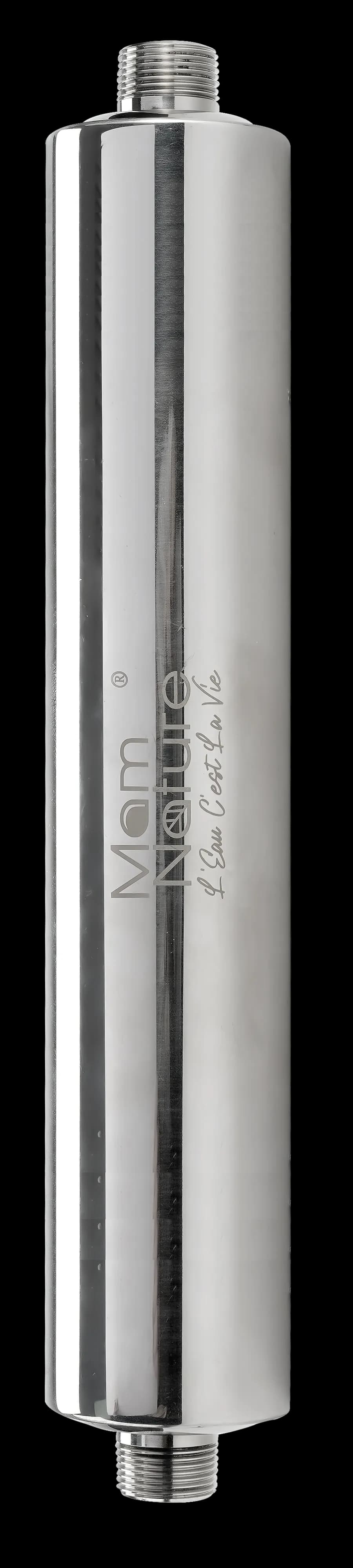
A magnetic limescale conditioner — correctly engineered with sufficient field strength — shifts precipitation toward aragonite, producing a non-adhesive powder that flushes away. The change is most visible on heating elements (which accumulate scale fastest) and around tap aerators and shower heads.
Over time, continued aragonite formation can also dislodge existing calcite scale through an undercutting mechanism: aragonite crystals forming underneath the calcite layer gradually separate it from the surface. This "descaling" effect is observed over a period of months and is a useful indicator that the magnetic conditioning system is working.
Protect your appliances from calcite scale — no salt, no electricity.
Explore the Water LIMERelated Resources
Frequently Asked Questions
Why does aragonite not stick to pipes?
Aragonite has an orthorhombic crystal structure with needle-like or rounded particles that cannot form the interlocking plate bonds of calcite. Without the plate-stacking adhesion mechanism, aragonite crystals stay dispersed in the water flow and flush away rather than accumulating on surfaces.
Is aragonite limescale dangerous to health?
No. Both calcite and aragonite are calcium carbonate — chemically identical and non-toxic. The difference is purely structural. Aragonite in your drinking water or flush water is harmless and passes through plumbing without accumulating.
Can magnetic treatment convert existing calcite scale to aragonite?
Not directly — magnetic treatment affects newly precipitating calcium carbonate. However, as aragonite crystals form beneath existing calcite deposits, they gradually undercut and dislodge the calcite over 3–6 months. This progressive descaling effect is a well-documented but slow process.
At what water hardness level does scale become a problem?
Scale formation becomes economically significant above approximately 200 mg/L CaCO₃ (about 20°fH or 11 °dH). At this hardness, heating elements and appliances show measurable efficiency losses within 1–2 years without treatment. Above 35°fH (350 mg/L), annual descaling or continuous treatment is effectively mandatory to maintain appliance efficiency.
How do I know if my magnetic conditioner is working?
Look for a change in the texture of deposits on shower heads, tap aerators, and kettle elements over 4–8 weeks. Working magnetic conditioning produces soft, powdery residue rather than hard, crunchy scale. You can also rub a small sample between your fingers — aragonite crumbles, calcite does not.
Sources & References
- Coey J.M.D. & Cass S. (2000). Magnetic water treatment. Journal of Magnetism and Magnetic Materials 209(1–3):71–74.
- Gabrielli C. et al. (2001). Magnetic water treatment for scale prevention. Water Research 35(13):3249–3259.
- Alimi F. et al. (2009). Effect of magnetic water treatment on crystal growth of CaCO₃. Water SA 35(2).