

Reverse Osmosis Water Waste Explained — How Much Water Does an RO System Actually Throw Away?
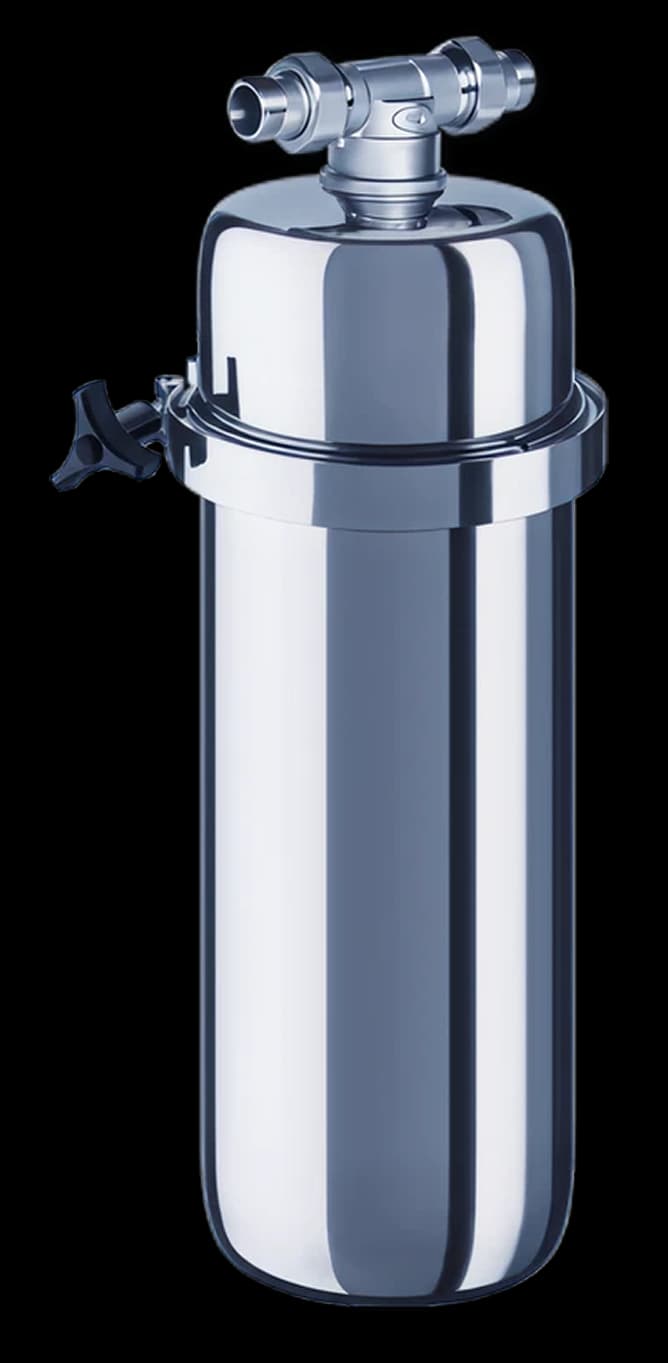
Reverse osmosis (RO) is the most widely sold residential water purification technology, and for decades the industry has spoken about its water consumption in soft terms — "a small amount of wastewater," "some reject water." In practice, most household RO systems discard between 3 and 4 litres of water down the drain for every 1 litre of filtered water they produce.
For a family of four drinking 8 litres a day, that translates to between 8,700 and 11,700 litres of tap water flushed to sewer per year — water you have already paid for, heated in some cases, and pressurised through your plumbing. In drought-prone regions, the number matters.
This article explains why RO membranes work this way, what the recovery ratios actually look like in modern residential systems, how to calculate the cost for your own household, and when a non-wasteful alternative makes more sense.
What "Water Waste" Means in Reverse Osmosis
An RO membrane is a semi-permeable polymer film with pores small enough to reject dissolved salts, heavy metals, PFAS, nitrates, and most organic molecules. To force water through those pores, the system applies pressure — typically 40–80 psi (2.7–5.5 bar) from your household supply, sometimes boosted by an electric pump.
The output stream splits in two. The "permeate" is the purified water that passes through the membrane and reaches your tap. The "concentrate" — also called brine, reject, or retentate — is the water that carries away the contaminants the membrane just rejected. Without that brine stream, dissolved solids would accumulate against the membrane surface and rapidly destroy it through fouling and scaling.
The brine is not optional. It is a physical requirement of how RO works. The question is not whether an RO system produces waste, but how much.
The Recovery Ratio — What It Means and Why It Matters
Recovery ratio is the industry term for the fraction of feed water that becomes permeate. A recovery ratio of 25% means 1 litre of drinking water is produced for every 4 litres drawn from the tap — and 3 litres go to the drain.
Typical residential under-sink RO systems sold in Europe and the United States operate at 20–30% recovery, which corresponds to a waste-to-product ratio of 4:1 or 3:1. "High efficiency" or "zero-waste" residential systems marketed in recent years claim 40–60% recovery (1.5:1 to 1:1 ratio), achieved either by recirculating concentrate through a permeate-pumped tank or by using a smaller, slower membrane.
Commercial and industrial RO installations achieve higher recovery — 75% or more — but only by using multi-stage configurations, energy recovery devices, and pre-treatment that would be uneconomic in a residential setting.
The recovery number you see on a product spec sheet is measured under laboratory conditions with soft feed water at 25°C. Real-world performance is almost always lower, because cold water increases membrane viscosity and hard water forces shorter run cycles to prevent scaling.
How Much Water a Residential RO System Wastes Per Year
The arithmetic is simple. A family of four typically drinks 8 litres of filtered water per day (drinking, cooking, coffee, tea). At a 3:1 waste ratio, that means 24 litres of brine discarded per day, or 8,760 litres per year. At a 4:1 ratio, it is 11,680 litres per year.
Some households also use filtered water to fill kettles, ice trays, pet bowls, and humidifier reservoirs — pushing total filtered consumption to 12–15 litres per day and total annual waste closer to 18,000 litres for a 4:1 system.
That is roughly equivalent to running a modern dishwasher for 1,800 cycles, or refilling a family-size hot tub four times over. In a household with metered water and sewage charges, the cost is small in absolute terms — €15–40 per year in most European municipalities — but the environmental footprint is real, particularly in regions that already restrict outdoor watering in summer.
Why "Permeate-Pumped" and "Zero-Waste" RO Systems Are Not Truly Zero-Waste
A common marketing claim in the residential RO category is the "zero-waste" or "100% recovery" system. These systems do not eliminate brine — physical chemistry does not allow that — but instead reroute the concentrate stream back into the cold-water supply line of the house, where it becomes part of the water used for showering, flushing toilets, and washing dishes.
From the homeowner's perspective, the brine appears to disappear, because it is no longer flowing into the drain. In reality, the household is now showering and washing with concentrate that contains 2–4× the dissolved contaminants of the original tap water, including any rejected nitrates, heavy metals, or PFAS the RO membrane just removed for drinking purposes.
For most contaminants, this dilution effect is negligible at the scale of an entire household. For PFAS and heavy metals, the contaminant load you are now exposing your skin to is measurably higher than your starting tap water. Whether that matters depends on the contaminant and the rejection ratio of the membrane.
Mineral Stripping — The Other Cost of RO
Reverse osmosis is non-selective. The membrane rejects PFAS and lead with the same physical mechanism it uses to reject calcium, magnesium, and bicarbonate. Permeate from a residential RO unit typically has a total dissolved solids (TDS) reading below 20 mg/L — close to distilled water.
Demineralised water is mildly aggressive toward copper plumbing and tastes flat to most people. Manufacturers address this by adding a remineralisation cartridge downstream of the membrane, which dissolves calcium carbonate granules back into the permeate. The added minerals are not the same as those naturally present in spring water — they are dosed in from a consumable cartridge that needs replacement every 6–12 months.
The World Health Organization has noted that long-term consumption of demineralised water may have measurable health effects related to magnesium and calcium intake, particularly in populations whose diet does not compensate. The WHO does not currently recommend demineralised drinking water as a long-term household supply.
When RO Still Makes Sense
Reverse osmosis is the right technology for three specific situations. First, very high total dissolved solids — typically above 1,000 mg/L — where no other residential technology can produce drinking-quality water. This occurs in brackish-groundwater regions, on small islands, and in some industrial settings.
Second, hospital, laboratory, and electronics manufacturing applications where the goal is explicitly demineralised water for instrument cleaning, dialysis fluid preparation, or ultra-pure rinses. RO is the standard pre-treatment for these processes.
Third, point-of-use drinking water in settings where local water already has acceptable mineral content but contains a specific high-concentration contaminant — for example, arsenic in some rural well systems — that other technologies struggle to reduce to safe levels.
For the typical European or North American household on a municipal supply with normal mineral content and concerns about PFAS, chlorine, pesticides, heavy metals, or microplastics, RO is mismatched to the problem. It removes the contaminants but also removes the minerals you wanted to keep, and it discards 3–4× more water than it produces.
How Adsorption-Based Filtration Avoids the Waste Stream
Adsorption-based filtration works on a different physical principle than membrane filtration. Instead of pushing water through a barrier and rejecting the contaminants, adsorption uses a filter medium with high surface area to bind specific contaminants as the water flows through. The water that enters the filter exits the filter — there is no brine stream, no concentrate to discard.
The Mam Nature Fine Filter cartridge, developed in collaboration with ETH Zurich, uses an amyloid protein-fibre matrix to selectively adsorb PFAS, heavy metals, microplastics, chlorine, and pesticides. Single-pass laboratory testing has measured greater than 96% to greater than 98.5% PFAS retention. The cartridge does not remove calcium, magnesium, or bicarbonate — the minerals that make water taste and behave normally in your kitchen.
Because there is no brine reject, a whole-house point-of-entry installation produces 100% of its input water as filtered output. A family of four that would discard 8,000–12,000 litres per year through an under-sink RO instead discards zero.
The Cost Comparison Most Buyers Miss
A residential RO system has three ongoing costs that most buyers underestimate at purchase time. The first is wasted water — €15–40 per year in metered municipalities, more in drought-pricing regions. The second is filter replacement — most residential RO systems require four to five separate cartridges replaced on staggered schedules of 6 months to 2 years, plus the membrane itself every 2–3 years. Total annualised consumables: €150–250. The third is the remineralisation cartridge, if fitted — typically €30–60 per year.
A whole-house adsorption-based system has one consumable, the cartridge, replaced once per year. There is no brine, no remineralisation stage, no membrane to fail. The annualised consumable cost for a Mam Nature system is €240 — close to the consumable cost of a well-maintained residential RO, but applied to every tap in the house instead of one tap in the kitchen.
A whole-house filter that produces no waste water and preserves natural minerals.
Explore Essential PlusRelated Resources
Frequently Asked Questions
How many litres of water does a residential RO system waste per litre of drinking water?
A typical residential under-sink reverse osmosis system discards 3 to 4 litres of brine for every 1 litre of drinking water produced. "High-efficiency" systems advertised at 1:1 ratio typically achieve this only by recirculating concentrate back into the cold-water supply line of the house, which is not the same as eliminating the waste.
Is reverse osmosis water bad for you?
Short-term consumption of demineralised water is not harmful, but the World Health Organization has noted that long-term consumption of fully demineralised water without dietary compensation may reduce magnesium and calcium intake. RO systems address this with a remineralisation cartridge, which adds calcium carbonate back into the water after the membrane.
Can I use the brine water from my RO system?
The brine is not toxic — it contains the contaminants from your original tap water concentrated by 2 to 4 times. It is generally safe for irrigation of non-edible plants, flushing toilets, or outdoor cleaning. Reusing it for laundry, dishwashing, or showering is not advisable if your source water contains heavy metals or PFAS.
Does a whole-house water filter waste water like RO does?
No. Adsorption-based whole-house filters such as the Mam Nature point-of-entry systems do not produce a brine stream. Every litre that enters the filter exits as filtered water. There is no recovery ratio because there is no rejection mechanism — contaminants are bound to the filter medium and removed when the cartridge is replaced once per year.
Are "zero-waste" RO systems actually zero-waste?
No. Zero-waste residential RO systems do not eliminate the brine stream — they redirect it back into the household cold-water supply line, where it becomes part of the water used for showering, dishwashing, and laundry. The concentrate is now diluted by the household's overall water use rather than discarded, but the contaminants the RO membrane just rejected are still circulating through the rest of your plumbing.
Sources & References
- US EPA. "Reverse Osmosis." Drinking Water Treatment Technologies Reference Guide.
- World Health Organization (2005). "Nutrients in Drinking Water." Public Health and Environment.
- Water Quality Association. "Reverse Osmosis Technical Fact Sheet."
- Bolisetty, S., Peydayesh, M., Mezzenga, R. (2020). Sustainable technologies for water purification from heavy metals: review and analysis. Chemical Society Reviews 49, 463-487.
- Mam Nature Swiss AG — ETH Zurich University Laboratory Performance Certificate (2024). Independent filtration validation report.