How Much Does a Whole House Water Filter Cost? 2026 Guide
A whole house water filter costs between €1,090 and €3,598 at the Mam Nature tier, plus €80–200 for professional installation if you do not install it yourself, and €240 per year for the replacement cartridge. Those are the numbers. But purchase price is the wrong metric for evaluating a water treatment system. The correct metric is total cost of ownership over five or ten years — which tells a very different story when compared against bottled water spending, under-sink RO maintenance, or the long-term cost of scale damage to boilers and appliances.
This guide gives you the complete cost picture: what moves you from one pricing tier to the next, what installation actually costs in Europe, how to calculate your five-year and ten-year ownership cost, and how each tier compares against realistic alternatives. Every number in this guide is based on real product prices and independently verifiable reference data for bottled water and RO consumables.
Use the Mam Nature savings calculator at /savings-calculator to model your specific household's numbers — household size, current bottled water spend, and local water conditions all affect the payback timeline significantly.
The Four Price Tiers and What Moves You Between Them
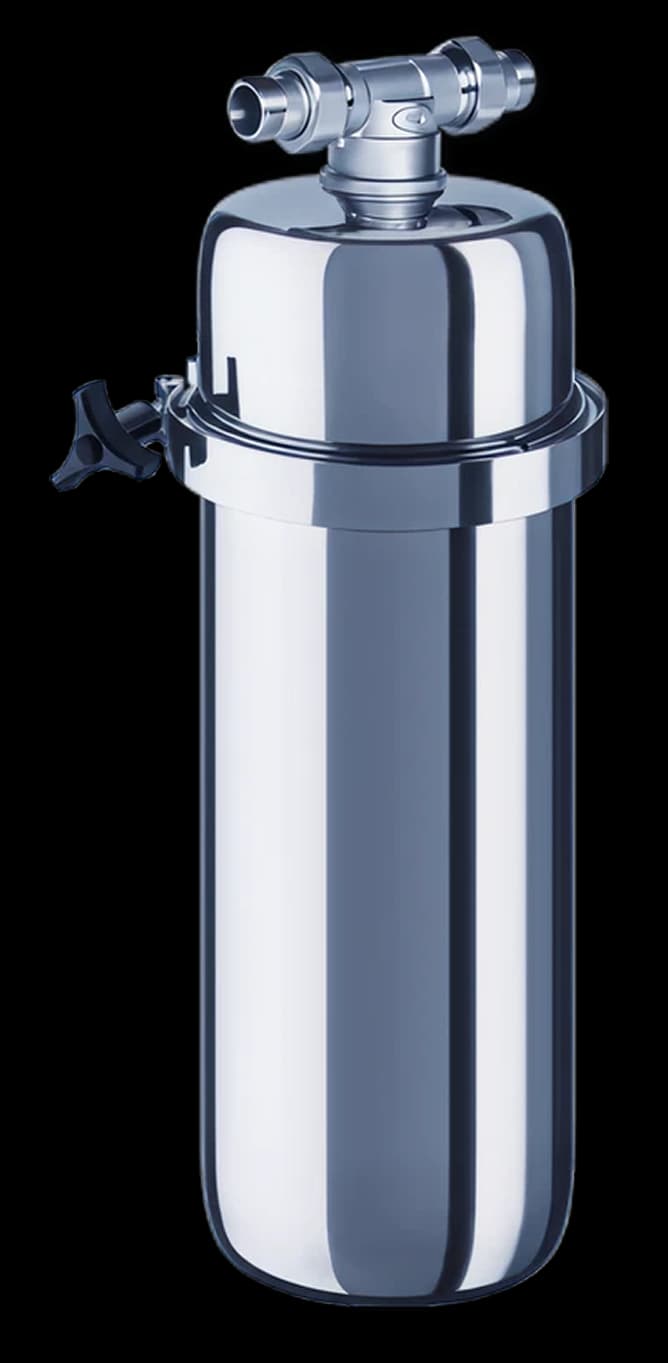
Mam Nature's whole-house product range is structured around four tiers, each adding a specific capability over the previous one. The entry tier, the Essential at €1,090, is a single-housing point-of-entry system containing the amyloid protein-fibre adsorption cartridge developed in collaboration with ETH Zurich University. The public report records controlled single-pass results for seven named PFAS, named metals, free residual chlorine, Bentazon, ibuprofen and other specified analytes. It does not measure microplastics or establish performance for every contaminant. It is the right starting point for a household on a clean municipal supply with no visible sediment issues.
The Essential Plus at €1,360 adds an automatic-backwash particle pre-filter upstream of the adsorption cartridge. The pre-filter is the correct step up if your water shows visible sediment, rust discolouration, or if you are on a well supply where turbidity varies with rainfall. Protecting the adsorption cartridge from particle fouling extends its effective service life and ensures consistent performance. The automatic backwash means the pre-filter cleans itself on a timer cycle — no manual intervention.
The Complete Set at €2,998 adds the Water LIME anti-limescale device and the Dynamizer to the Essential filter. The Water LIME uses a magnetic field to convert calcite crystals in hard water to non-adhesive aragonite, preventing scale accumulation in boilers, heat exchangers, dishwashers, and pipe walls. No salt, no electricity, no chemicals — a permanent installation with no consumables. This tier is the correct choice for households in hard-water regions (Switzerland, Germany, Belgium, Netherlands, parts of France and Italy) where scale damage to appliances is a material concern.
The Complete Set Plus at €3,598 is the fully specified system: particle pre-filter (auto-backwash), adsorption cartridge, Water LIME, and Dynamizer. It provides particle protection, filtration for compounds named in the public performance report, and hard-water conditioning in a single installation. This is the appropriate choice for households combining all three concerns: sediment or well water, chemical contamination, and high water hardness.
Annual Consumable Cost
The ongoing cost of a Mam Nature system is deliberately simple: one cartridge per year, €240. The cartridge is the only consumable across all four tiers. The particle pre-filter in the Essential Plus and Complete Set Plus self-cleans via automatic backwash and does not require replacement under normal operating conditions. The Water LIME has no consumable — its magnetic field is permanent. The Dynamizer has no consumable.
Cartridge replacement takes approximately ten minutes and requires no specialised tools — the housing is designed for tool-free cartridge access. For a household of four on a standard municipal supply, one cartridge per twelve months is the expected service interval. Households with higher flow demands or elevated inlet contamination may require replacement at nine months; households of two with low flow may extend to fifteen months. Mam Nature's performance indicators will guide the timing: flow rate reduction at the outlet is the earliest observable sign that cartridge capacity is approaching its limit.
Installation Cost in Europe
A point-of-entry whole-house filter installs on the cold mains supply line where it enters the building, typically in a utility room, basement, or under-sink space near the stopcock. The installation requires cutting the main supply pipe, inserting a bypass valve assembly, and connecting the filter housing using standard BSP fittings.
For a competent DIY installer with basic plumbing tools, the material cost is €0–€50 (PTFE tape, push-fit fittings, isolation valve if not already present). Mam Nature systems ship with a drill template, full installation guide, and all connection hardware. If you prefer to use a professional plumber, labour costs in Europe vary by country and access conditions: expect €80–€150 in Germany, €100–€200 in Switzerland, and €80–€160 in France for a straightforward main-line connection. Complex installations — multiple floors, difficult access, older iron pipework — may run higher. Getting a quote from a local plumber before purchase lets you include this in your total cost calculation.
Five-Year and Ten-Year Total Cost of Ownership
The table below shows the purchase-plus-consumables total cost of ownership for each Mam Nature tier over five and ten years. Installation cost (assumed €0 for DIY or €150 for a professional) is listed separately so you can apply the figure relevant to your situation.
Essential (€1,090 purchase, €240/year cartridge): five-year total €2,290; ten-year total €3,490. Essential Plus (€1,360 purchase, €240/year): five-year €2,560; ten-year €3,760. Complete Set (€2,998 purchase, €240/year): five-year €4,198; ten-year €5,398. Complete Set Plus (€3,598 purchase, €240/year): five-year €4,798; ten-year €5,998. These figures assume no service calls, no component failures, and one cartridge per twelve months. The filter housing carries a ten-year warranty, meaning the capital cost is not expected to recur within the ownership period.
Whole House Filter vs Bottled Water — The Real Comparison
Bottled water is the most common alternative that families use before installing a filtration system — and the cost comparison is dramatic once you account for full household consumption rather than just drinking water.
In Germany, widely purchased bottled water brands retail at approximately €1.19 per litre for premium mineral water (Evian) and €0.79 per litre for mid-range mineral water (Volvic), with private-label supermarket water at €0.17 per litre. In France, Evian retails at approximately €0.86 per litre and Cristaline at €0.27 per litre. Swiss pricing for premium brands is comparable to German premium levels. A family of four consuming 8 litres per day of drinking water spends: at Evian Germany prices (€1.19/L): €1.19 × 8 × 365 = approximately €3,475 per year. At Volvic prices (€0.79/L): approximately €2,307 per year. At Cristaline France prices (€0.27/L): approximately €789 per year. Even at private-label German prices (€0.17/L): €497 per year, purely for drinking water — not cooking, not rinsing food, not coffee or tea, and covering none of the chemical contamination at the shower, bath, or kitchen sink.
Against the Essential tier at a five-year total of €2,290 (DIY installation), the break-even point versus Evian-Germany bottled water is less than eight months. Against Volvic Germany, break-even is approximately twelve months. Even against private-label water, break-even is reached before year five — and the Mam Nature system filters every tap in the house, not just the drinking water consumed in bottles.
Whole House Filter vs Under-Sink Reverse Osmosis
Under-sink reverse osmosis units are a popular point-of-use alternative for drinking water, positioned as a lower-cost entry point into home filtration. The purchase price of a mid-range residential RO unit is €200–€500. However, the ongoing cost structure is more complex than it appears at initial purchase.
A typical under-sink RO system uses four to five cartridge stages, each with different replacement intervals: sediment pre-filter every 3–6 months, carbon pre-filter every 6–12 months, RO membrane every 2–3 years, carbon post-filter every 6–12 months. Annual consumable costs for a four-stage system run approximately €150–€250 per year for cartridges, plus €80–€150 for the RO membrane when it falls due. Add the cost of wasted water: residential RO systems reject 3–4 litres of water (sent to drain as brine) for every 1 litre of filtered output. For a family consuming 8 litres per day of filtered water, an RO unit wastes 24–32 litres per day — 8,760–11,680 litres per year. At European water utility rates of €1.50–€4.00 per cubic metre, this waste adds €13–€47 per year in direct water cost, and a larger environmental footprint.
Critically, an under-sink RO unit covers only one tap — typically the kitchen drinking tap. Every shower, bath, laundry load, and cooking use in the rest of the house runs unfiltered. A whole-house point-of-entry system delivers filtered water to every outlet for a comparable or lower long-term cost, while also protecting plumbing and appliances from the chlorine and chemical load that damages seals, valves, and heating elements over time. For a detailed comparison of RO versus POE filtration, see the article on whole-house filter vs RO.
How to Calculate Your Personalised Payback Period
The variables that most affect your individual payback calculation are: current bottled water spend per month, household size, water hardness (which affects appliance maintenance costs in Complete Set scenarios), and whether you already pay for a water treatment subscription. The Mam Nature savings calculator at /savings-calculator takes these inputs and returns a personalised year-by-year cost comparison against your current spending.
Common inputs and outputs from the calculator illustrate the range: a single-person household buying premium bottled water for cooking and drinking sees payback on the Essential in approximately 24–30 months. A family of four with a premium water habit and a hard-water area sees payback on the Complete Set in 18–24 months when appliance maintenance savings are included. A family primarily using private-label water sees a longer payback of 4–6 years, but is still meaningfully ahead at the ten-year mark — and has filtered shower and bath water, which bottled water does not provide.
Calculate exactly how quickly your Mam Nature system pays for itself based on your household.
Open Savings CalculatorRelated Resources
Frequently Asked Questions
What is the cheapest whole house water filter available?
The entry price for a validated whole-house adsorption filter certified under independent laboratory testing is €1,090 for the Mam Nature Essential. Cheaper whole-house housings exist at €150–€400, but these typically use standard activated carbon or sediment-only cartridges with limited documented removal performance for PFAS, heavy metals, or chlorine byproducts. Total cost of ownership — including annual cartridge replacements — is more meaningful than purchase price. A €200 system with €100/year cartridges costs more over five years than it initially appears.
Are there hidden costs I should budget for?
For the Mam Nature range: no. The annual cartridge at €240 is the only recurring cost. There are no required service contracts, no salt purchases, no electricity draw, and no wasted water. If you hire a plumber for installation, budget €80–€200 for a standard main-line connection in Europe. Replacement cartridges can be purchased directly and installed in ten minutes without tools.
Does the price change based on my water quality?
The system tier you need depends on your water quality, but the annual consumable cost remains €240 regardless of tier. Households with very high inlet contamination or sediment load may find their cartridge reaches capacity before twelve months, requiring replacement at nine to ten months — effectively a slightly higher annual consumable cost. A certified water test before purchase lets you size the system correctly and set realistic service interval expectations.
Is a whole house water filter worth the cost?
For a family of four with any bottled water spending or appliance scale concerns, the ten-year financial case is straightforwardly positive across all four tiers. Beyond the financial calculation: a point-of-entry system filters every tap — showering, cooking, drinking — delivering benefits that a single-tap or bottled water approach cannot. The WHO has documented health associations between long-term PFAS exposure and immune function, thyroid health, and developmental outcomes in children. The cost of filtration needs to be evaluated against these non-financial dimensions as well.
Can I spread the cost of a whole house filter over time?
Mam Nature offers financing options at checkout. This allows the purchase price to be spread across monthly payments, reducing the upfront capital requirement while the savings from reduced bottled water spending and avoided appliance maintenance begin accumulating immediately. Use the savings calculator at /savings-calculator to see whether month-one net savings are positive once financing costs are factored in.
Sources & References
- World Health Organization (2022). Per- and polyfluoroalkyl substances (PFAS) in drinking water: background document for development of WHO guidelines.
- Water Quality Association (2024). Cost of Water Treatment — Consumer Research Report.
- European Environment Agency (2023). Plastics, the circular economy and Europe's environment — bottled water consumption and environmental footprint data.
- US EPA (2023). Water Sense — Water Efficiency and Household Water Cost Data.
- Bolisetty, S., Peydayesh, M., Mezzenga, R. (2020). Sustainable technologies for water purification from heavy metals. Chemical Society Reviews 49, 463–487.