How ETH Zurich University Removes 99.9997% of Radioactive Waste from Hospital Water
Every year, hospitals worldwide discharge millions of litres of radioactive wastewater into public sewage systems. Patients undergoing nuclear medicine procedures — PET scans, thyroid treatments, cancer therapy — excrete radioactive isotopes in urine and faeces for days after treatment. Conventional sewage treatment cannot remove these radionuclides.
In 2020, researchers at ETH Zurich University and Inselspital Bern published a landmark study in Environmental Science: Water Research & Technology demonstrating that amyloid hybrid membranes can remove up to 99.9997% of clinically relevant radioactive isotopes from real hospital wastewater — including from active patient samples collected at the hospital.
This is the same membrane technology at the core of the Swiss Water Cartridge from Mam Nature. Here is a detailed look at what the researchers did, what they found, and why it matters for hospitals, regulatory bodies, and communities near nuclear facilities.
The Problem: Radioactive Isotopes in Hospital Wastewater
Nuclear medicine is a rapidly growing field. PET-CT scans use gallium-68 (Ga-68) and fluorine-18 (F-18). Thyroid diagnostics and cancer treatments use iodine-123 (I-123), iodine-131 (I-131), and technetium-99m (Tc-99m). Targeted cancer radiotherapy increasingly relies on lutetium-177 (Lu-177).
After administration, a significant fraction of each dose is excreted by the patient within hours to days. This radioactive urine and faeces enters the hospital's wastewater stream. Regulations in most countries require decay-in-storage for short-lived isotopes, but compliance is inconsistent, and longer-lived isotopes like I-131 (half-life: 8 days) and Lu-177 (half-life: 6.6 days) remain a persistent challenge.
Conventional activated carbon and sand filtration — the workhorses of municipal wastewater treatment — have negligible effectiveness against dissolved radionuclides. The result is that measurable concentrations of radioactive isotopes have been detected in rivers, drinking water sources, and sediments downstream of hospitals across Europe and North America.
The ETH Zurich University study, led by Professor Raffaele Mezzenga's group in collaboration with the nuclear medicine department at Inselspital Bern (University Hospital Bern), set out to test whether amyloid hybrid membranes could solve this problem at scale.
The Technology: Amyloid Hybrid Membranes
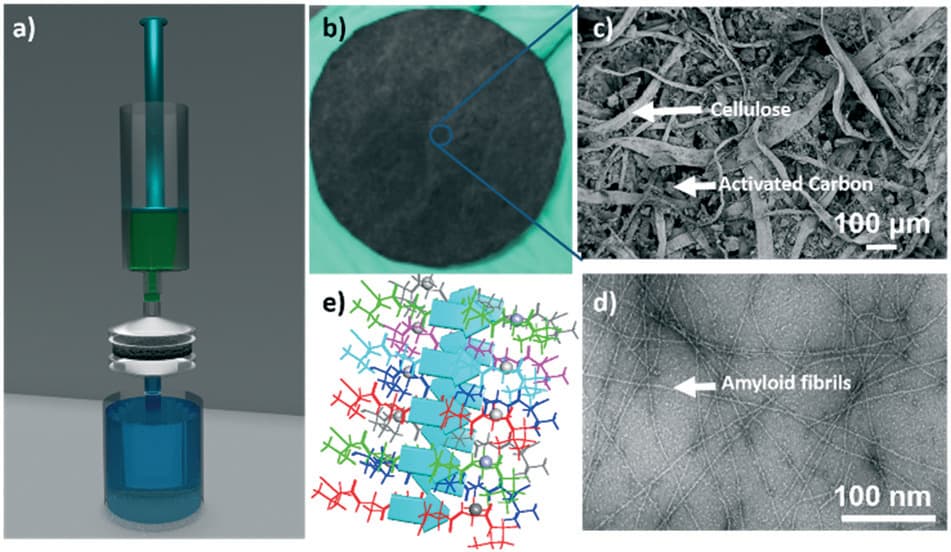
The membrane at the heart of the study is built from three components: whey protein amyloid fibrils, activated carbon, and cellulose. Whey proteins — specifically beta-lactoglobulin — are denatured under controlled acidic conditions and heat to self-assemble into amyloid fibrils: ultra-thin, nanometre-scale protein ribbons with extraordinary surface area and a dense array of binding sites.
These amyloid fibrils are then combined with activated carbon granules and formed into a sheet using cellulose fibres as a structural scaffold. The resulting membrane has a hierarchical porous structure visible under scanning electron microscopy (SEM): large pores allow water to flow rapidly, while the nanoscale fibril network captures contaminants with high selectivity.
The mechanism of radionuclide capture is primarily electrostatic adsorption. The amyloid fibril surface presents a high density of carboxyl and amino groups that bind positively charged metal ions — including radioactive cations — with extremely high affinity. Activated carbon contributes additional adsorption capacity for organic-bound isotopes.
Crucially, this filtration operates at ambient temperature and pressure with no chemical additives, making it suitable for hospital settings where energy efficiency and operational simplicity are essential.
The Study: What Researchers Tested
The ETH Zurich University team, led by Sreenath Bolisetty, Nastasia Coray, Archana Palika, George Prenosil, and Raffaele Mezzenga, conducted a multi-phase study published in December 2020 (DOI: 10.1039/d0ew00693a).
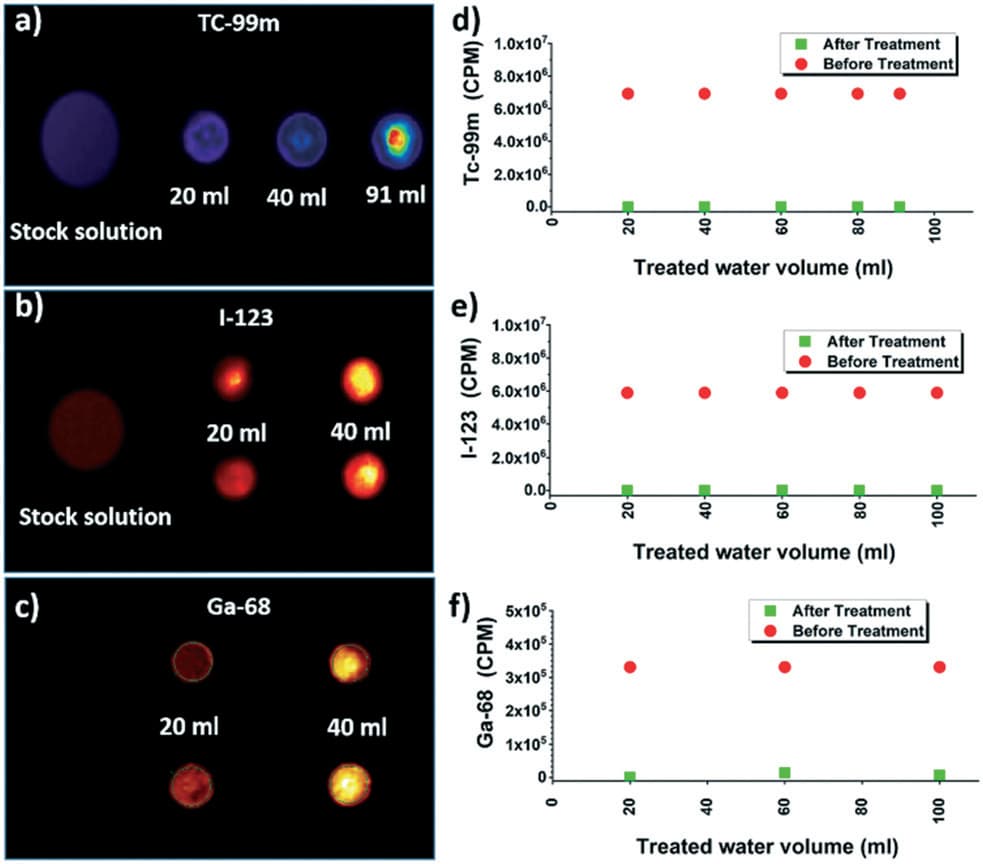
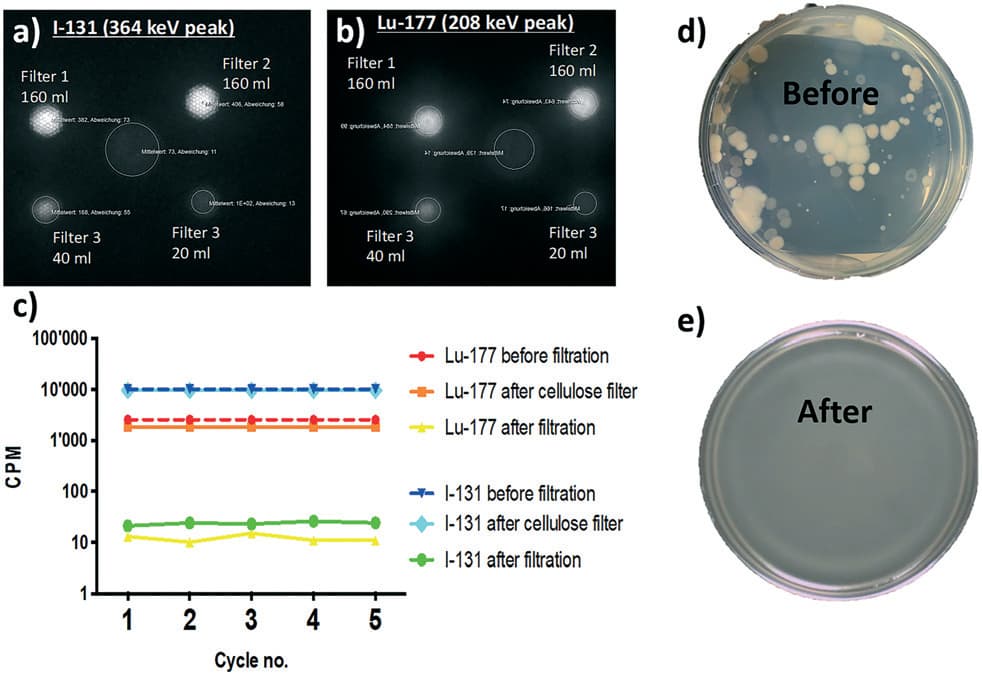
In the laboratory phase, the membrane was challenged with controlled aqueous solutions of four clinically common radioactive isotopes: technetium-99m (used in over 80% of nuclear medicine diagnostic procedures), iodine-123 (thyroid imaging), gallium-68 (PET scanning), and iodine-131 (thyroid cancer treatment).
In the hospital phase — the most significant validation — the researchers collected real patient wastewater directly from the nuclear medicine ward at Inselspital Bern. This included urine samples from patients who had recently received radioactive iodine-131 and lutetium-177 as part of their treatment. This is real clinical radioactive waste, not a laboratory simulation.
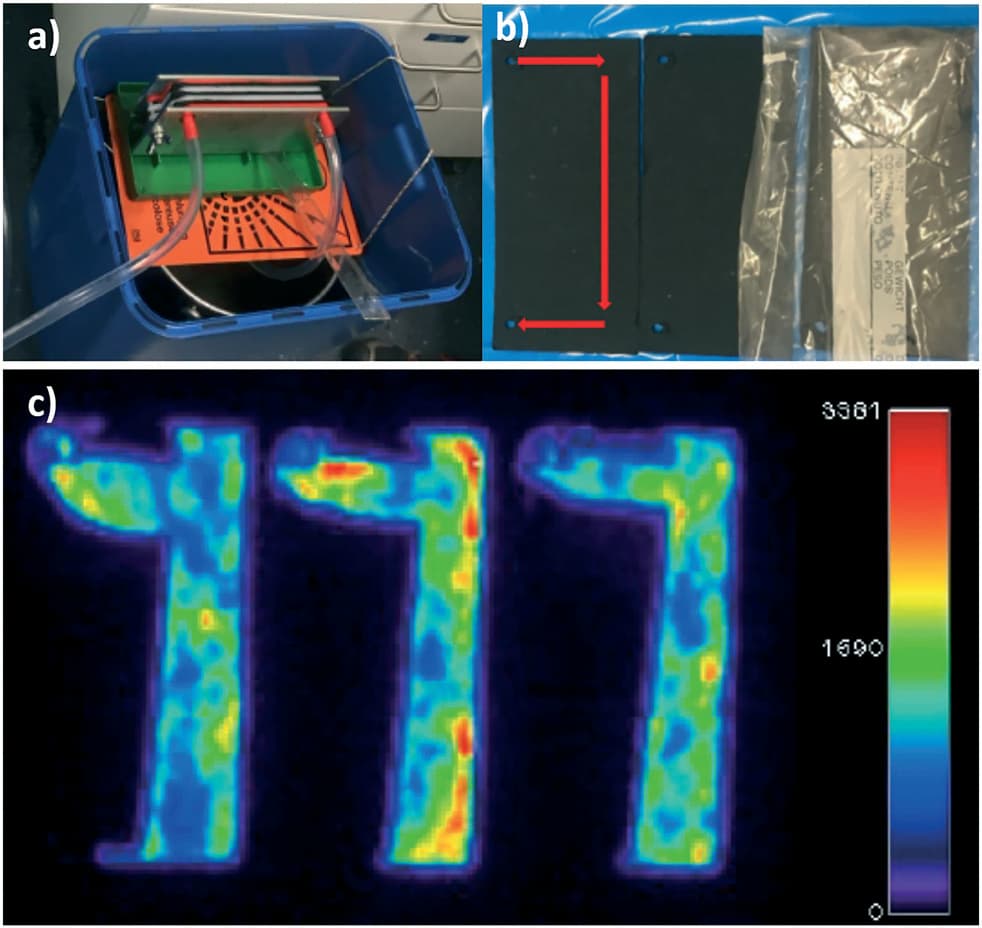
Activity measurements were taken using gamma counters before and after filtration. Radioactive contamination remaining on the filter was visualised using clinical imaging equipment — planar scintigraphy and PET-CT scanners — the same devices used to image patients. Bacterial contamination was also measured to assess the membrane's potential for secondary contamination management.
The Results: Removal Efficiencies
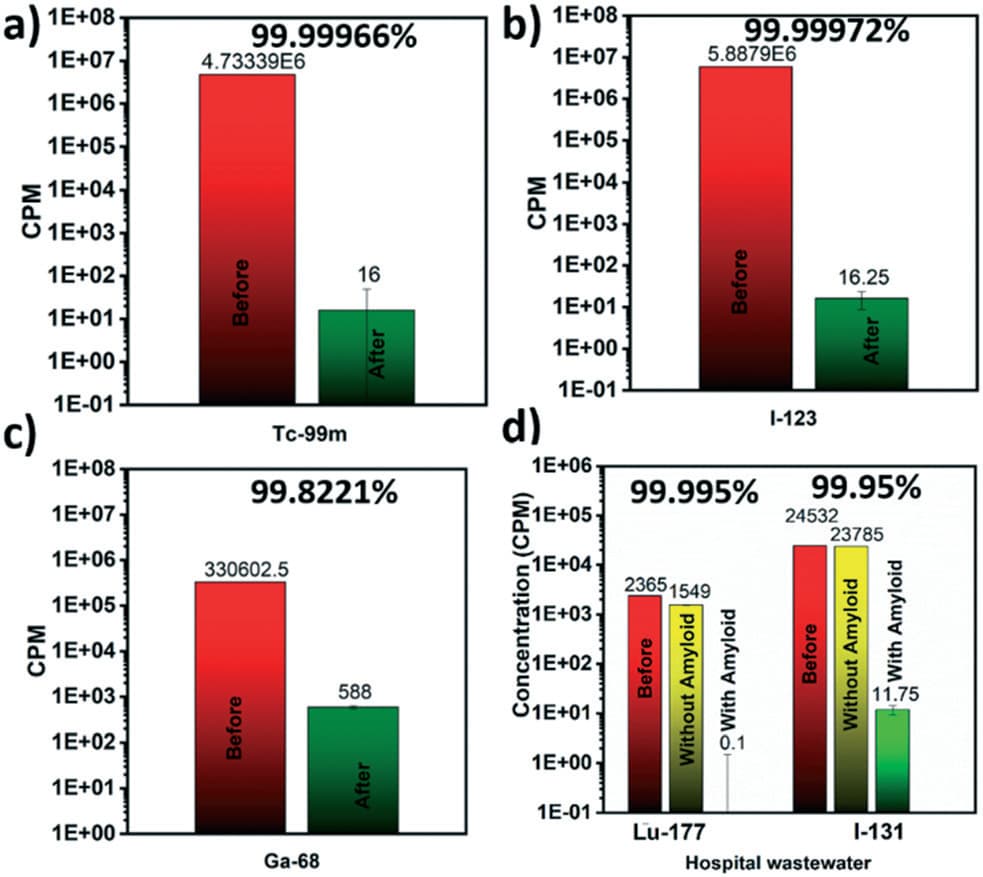
The laboratory results were striking. The amyloid hybrid membrane achieved the following removal efficiencies for spiked aqueous solutions: Technetium-99m (Tc-99m): 99.9997% removal. Iodine-123 (I-123): 99.9997% removal. Gallium-68 (Ga-68): 99.8221% removal. Iodine-131 (I-131): 99.9958% removal.
The real hospital wastewater results confirmed performance in a far more complex matrix. Patient urine contains proteins, salts, metabolites, and other organic compounds that can compete for adsorption sites. Despite this, the membrane achieved: I-131 removal from patient urine: 99.9958%. Lu-177 removal from patient urine: 99.9552%.
To put these figures in context: a single pass through the membrane reduced radioactivity by a factor of 10,000 to 100,000. Water that entered the membrane at typical hospital wastewater activity levels exited well below environmental discharge limits.
The gamma counter images and PET-CT scans visualised the captured radioactivity as a bright band concentrated within the membrane — confirming that the isotopes were indeed retained by the filter material rather than passing through or being transformed chemically.
Scalability: From Lab to Real Hospital Infrastructure
A single-pass bench-scale membrane achieving 99.9997% removal in a laboratory is scientifically interesting but practically limited. The ETH Zurich University team addressed this by testing a crossflow filtration configuration — the industrial standard for high-throughput membrane filtration systems.
In crossflow mode, the water to be treated flows parallel to the membrane surface rather than perpendicular to it. This dramatically reduces membrane fouling (clogging), maintains high flow rates over extended operation, and allows continuous processing rather than batch treatment.
The crossflow results maintained the same order-of-magnitude removal efficiencies as the dead-end (batch) configuration, confirming that the technology scales to hospital-volume wastewater flows without significant performance degradation.
The researchers also demonstrated that spent membranes — which have captured radioactive material — can be handled as solid radioactive waste and processed through existing medical waste streams. This is a critical practical advantage: it converts a liquid radioactive waste problem into a contained solid waste problem, which is significantly easier to manage under existing nuclear medicine regulations.
Implications for Hospitals and Nuclear Facilities
The study establishes that amyloid hybrid membrane filtration is technically capable of treating clinical radioactive wastewater at the point of generation — within the hospital — before it enters the municipal sewage system. This point-of-source treatment model is fundamentally more effective than trying to treat diluted radioactivity at downstream municipal plants.
For hospitals with active nuclear medicine departments, this technology offers a pathway to compliance with emerging stricter effluent standards. The European ALARA (As Low As Reasonably Achievable) principle increasingly pressures hospitals to demonstrate radioactive effluent minimisation. Several European countries are reviewing their hospital radioactive discharge regulations.
Beyond clinical settings, the same membrane technology has demonstrated effectiveness against industrial radioactive wastewater — from nuclear power plant cooling water to mining and isotope production facilities. The amyloid fibril binding mechanism is not isotope-specific; it captures a broad spectrum of radioactive metal ions.
The Mam Nature Nuclear Filter adapts this ETH Zurich-validated technology for broader deployment — including protecting homes, facilities, and communities near nuclear installations or in regions with elevated naturally occurring radioactive material (NORM) in groundwater.
ETH Zurich-validated amyloid membrane technology — request a quote for nuclear-medicine grade filtration.
Contact Us About Custom SolutionsRelated Resources
Frequently Asked Questions
What radioactive isotopes does the amyloid membrane filter remove?
The ETH Zurich University study tested technetium-99m (Tc-99m), iodine-123 (I-123), iodine-131 (I-131), gallium-68 (Ga-68), and lutetium-177 (Lu-177). Removal efficiencies ranged from 99.8221% to 99.9997% across all tested isotopes in both laboratory and real hospital wastewater conditions. The binding mechanism targets a broad range of radioactive metal cations, including uranium, radium, and other naturally occurring radionuclides.
Is radioactive hospital wastewater actually a problem in Europe?
Yes. Multiple peer-reviewed studies have detected radioactive iodine-131, technetium-99m, and other medical isotopes in rivers and groundwater downstream of hospitals across France, Germany, Switzerland, and the UK. The World Health Organization and European nuclear regulators have identified hospital radioactive effluent as a growing concern as nuclear medicine procedures increase globally.
How does the Swiss Water Cartridge from Mam Nature relate to the ETH Zurich University study?
The Swiss Water Cartridge from Mam Nature uses the amyloid hybrid membrane technology developed and validated by ETH Zurich University in the 2020 Bolisetty et al. study. The same combination of whey protein amyloid fibrils, activated carbon, and cellulose scaffold forms the active filtration medium, adapted for installation in homes and facilities requiring protection from radioactive water contamination.
Can this filter remove radioactive contamination from drinking water?
Yes. While the ETH Zurich University study focused on hospital wastewater (which has much higher activity levels than typical contaminated drinking water), the underlying adsorption mechanism operates effectively across a wide range of concentrations. For drinking water contaminated with naturally occurring radioactive material (NORM) — such as radon, uranium, or radium from geological sources — or with fallout isotopes, the amyloid membrane achieves the same high removal efficiencies demonstrated in the study.
What happens to the radioactive material captured in the filter?
The captured radioactive isotopes remain adsorbed on the membrane material. Spent filters containing radioactive material must be handled as low-level radioactive waste and disposed of according to local nuclear regulatory requirements. In hospital settings this is straightforward since nuclear medicine departments already manage radioactive waste streams. For home installations treating naturally occurring radioactive material, spent filters are typically classified as naturally occurring radioactive material (NORM) waste, subject to local guidance.
Does the filter remove other contaminants besides radioactive isotopes?
Yes. The activated carbon component of the hybrid membrane provides broad-spectrum adsorption of organic contaminants including PFAS, pesticides, heavy metals, and pharmaceutical residues. The amyloid fibrils also capture heavy metal ions such as lead, arsenic, and mercury with high efficiency, as demonstrated in separate ETH Zurich University publications by the same research group.
Sources & References
- Bolisetty, S., Coray, N.M., Palika, A., Prenosil, G.A. & Mezzenga, R. (2020). Amyloid hybrid membranes for removal of clinical and nuclear radioactive wastewater. Environmental Science: Water Research & Technology, 6(12), 3249–3259.
- World Health Organization (2018). Radiation and health. WHO Fact Sheet.
- European Commission (2014). Council Directive 2013/59/Euratom — Basic Safety Standards for Protection Against Ionising Radiation.
- Inselspital Bern — Department of Nuclear Medicine. Clinical Radioactive Wastewater Characterisation (2019–2020).
- ETH Zurich University — Laboratory of Food and Soft Materials, Prof. Raffaele Mezzenga. Amyloid fibril water treatment research programme.